Gemini XI - From www.DickGordon.com
Launch: 09/12/66, 9:42 a.m EST
Landing: 09/15/66, 8:59 p.m. EST
Duration: 2 days, 23 hrs, 17 min, 8 sec
Orbits: 44
The primary objectives of Gemini XI were:
1)
To achieve a first orbit rendezvous and docking with the Agena Target
Vehicle.
2) Accomplish two Extravehicular Activity (EVA) tests.
3)
Perform docking practice, docked configuration maneuvers, tethered
operations and parking of the Agena target vehicle.
4) Demonstrate an automatic reentry.
5) Eight scientific experiments
Synergistic effect of zero-g and radiation on white blood cells.
Synoptic terrain photography.
Synoptic weather photography.
Nuclear emulsions.
Airglow horizon photography.
UV astronomical photography.
Gemini ion wake measurement.
Dim sky photography.
6) Four technological experiments were also on board.
Gemini 11 was the ninth crewed Earth-orbiting spacecraft of the Gemini series, carrying astronauts Charles "Pete" Conrad and Richard Gordon on a three-day orbital mission.
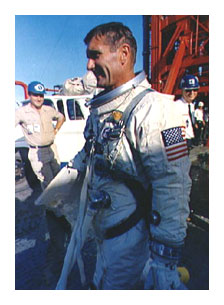
Trouble for the second scheduled send-off cropped up in a different area and much later in the countdown. Conrad and Gordon had completed the required rituals and headed toward pad 19 and their spacecraft when they heard that the Atlas (which would launch the Gemini Agena Target Vehicle), only 1,800 meters away, was having a problem with its autopilot. When the delay had stretched to an hour, the launch was postponed for two more days.
On l2 September 1966, Conrad and Gordon arrived at the pad and stepped into their seats exactly on time. The hatches were closed but they soon had to reopen Conrad's. He suspected that some oxygen was leaking from his side of the cabin. He was right. When the hatch had been fixed, the countdown went on.
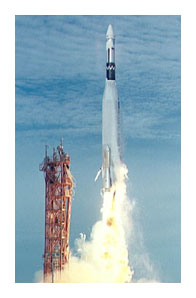
At 8:05 a.m., the Atlas carrying the Agena roared into action launching the target for the crew of Gemini XI. If ever two pilots waited anxiously for the starter's gun to crack, Conrad and Gordon did. For the first objective to be met (a first-orbit rendezvous with the Agena) they had to launch the Gemini spacecraft within two seconds of the launch of the Agena. It was the shortest launch window in the Gemini program.
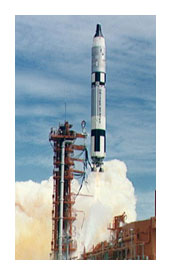
The Titan booster shoved Gemini XI toward a first-orbit rendezvous with near-perfect accuracy. At booster separation, when debris could be seen out the window. Gordon had warned himself not to look, but temptation got the better of him for a brief instant.
After five spacecraft maneuvers were made to adjust their orbit, the Agena, whose blinking lights they had been watching in the darkness, flashed into the sunlight over the Pacific and almost blinded them. The crew scrambled for sunglasses, then Conrad jockeyed the spacecraft to within 15 meters of the target's docking cone. Over the coast of California, only 85 minutes after launch, rendezvous in the first orbit was achieved consuming less fuel than expected.
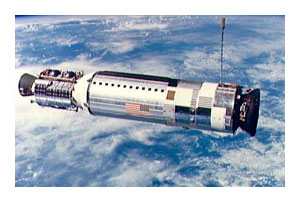
The only complaints the pilots had were about their dirty windows. Dirty windows had plagued all Gemini flights. Conrad had asked if Gordon could wipe his window when he went outside. He was told he could rub half the command pilot's window with a dry cloth and bring the rag back for testing.
Conrad and Gordon napped and rested a while longer, then started their next major task - preparation for Extravehicular Activity (EVA). Four hours before they were to open the hatch, the crew began to get their suits ready for the vacuum environment. They had practiced this so many times on the ground, Conrad said, that they soon realized they did not need all that time. Within 50 minutes, the gear was ready and running.
Briefly, the two men considered asking the Flight Director to let Gordon go out a revolution early. But they decided to keep on schedule.
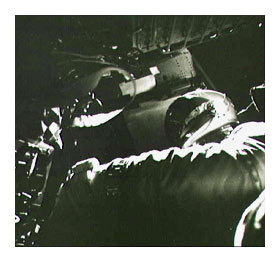
As expected, everything in the spacecraft that was not tied down began to float upward and outward - including Gordon. Conrad grabbed for a strap on the leg of Gordon's suit and held him in the seat.
Gordon then deployed a handrail, installed a camera and handed an experiment in to Conrad.
The first challenge was to attach the Agena to the Gemini capsule by a 30-meter tether. Gordon pushed himself forward to the target and grabbed some fixed handrails to pull himself astride the spacecraft nose.
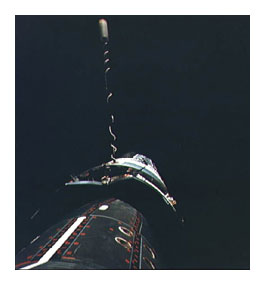 What had been
relatively easy in zero-g airplane flight training had become a monumental
task. In practice sessions in zero-g aircraft flights, Gordon had been able to
accomplish the tasks with his feet and legs wedged between the docking adapter
and the spacecraft to hold himself in place, leaving his hands free. But this
did not seem to work so well in the actual conditions of space. All he could do
was hold on with one hand and try to operate the tether clamp with the other.
He struggled for six minutes, finally securing the line. To Conrad it was
obvious that Gordon was running out of steam. With his face streaming with
sweat and his eyes stinging, Gordon groped blindly about.
What had been
relatively easy in zero-g airplane flight training had become a monumental
task. In practice sessions in zero-g aircraft flights, Gordon had been able to
accomplish the tasks with his feet and legs wedged between the docking adapter
and the spacecraft to hold himself in place, leaving his hands free. But this
did not seem to work so well in the actual conditions of space. All he could do
was hold on with one hand and try to operate the tether clamp with the other.
He struggled for six minutes, finally securing the line. To Conrad it was
obvious that Gordon was running out of steam. With his face streaming with
sweat and his eyes stinging, Gordon groped blindly about.
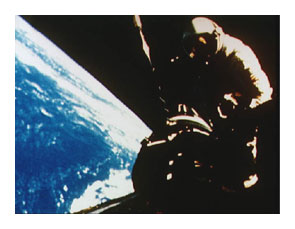
Because Conrad and Gordon were surrounded by so much loose gear, they opened the hatch an hour later and jettisoned all the umbilical extravehicular equipment.
As the Gemini flights progressed, each successive pilot continued to be amazed that the simplest tasks were so much harder than expected. "Gene Cernan warned me about this, and I took it to heart," Gordon later said. "I knew it was going to be harder, but I had no idea of the magnitude." Apparently the supporting engineers had no idea, either, since they still had not provided satisfactory restraints to help the crews.
The extreme exhaustion of past EVA pilots had sometimes adversely affected the rest of the mission, but Gordon's did not.
The next day, Conrad and Gordon skipped breakfast to get the cabin ready before the hard shove in their midsections sent them upstairs. They wanted things buttoned up as though for reentry. So they suited themselves, closed their faceplates, and stowed everything they could.
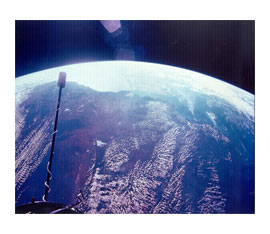
Over the United States in the 28th revolution, Conrad used the Agena to lower the apogee of the orbit. Firing for 23 seconds decreased speed and lowering the spacecraft. Another mission objective could be stamped "achieved."
Conrad and Gordon ate a quick meal and began preparations for the next EVA. In revolution 29, above Madagascar, Gordon opened the hatch and watched the sunset. Gordon stood on the spacecraft floor, held down by a short tether. This allowed him to forget about maintaining body position and left both hands free for his tasks. He mounted cameras in brackets without any difficulty. And conducted photographic experiments "Most enjoyable," he said of his two-hour standup period. So relaxed and well oriented was he that the monitoring physicians reported, "From a medical viewpoint, the standup EVA was relatively uneventful."
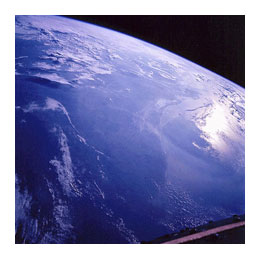
The crew rested and discussed the next major mission event - the tethered vehicle exercise.
Over the tracking station in Hawaii, the crew separated the two vehicles. When the tether between them was taut, Conrad rolled the Gemini spacecraft and blipped the thrusters to begin the slow cartwheel motion. A 38-degree-per-minute rotational rate was obtained and remained steady throughout the night side pass and it was then increased to a 55-degree-per-minute rate. This caused a slight artificial "gravitational acceleration" within the capsule, the first time such artificial gravity was demonstrated in space
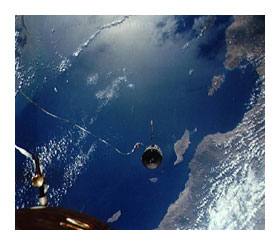
Conrad suggested that the Flight Director might send up a tanker - the crew would be happy to refuel, remain in orbit, and do some more work. But while this air-to-ground joking was going on, the crew was getting ready to land.
There was only one significant event left before Conrad and Gordon wrapped up their mission. A secondary objective called for the crew to make an automatic reentry. The commanders of other Gemini flights had flown their spacecraft down from 120,000 meters. This had enabled them to make corrections up to 550 kilometers downrange and 50 kilometers cross range. Conrad, however, would not fly the spacecraft with his hand controller in conjunction with computer directions; the spacecraft would follow these commands automatically.
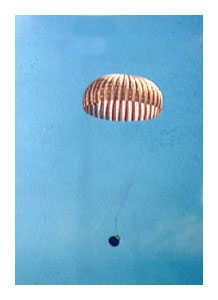
On September 15, 1966, after 70:41 hours of flight and in the 44th revolution of Earth, the retrorockets fired. Conrad and Gordon watched the computer closely. It certainly seemed to be working right. Conrad then disengaged his hand controller and put the system on automatic. On several occasions, the spacecraft displayed an almost human characteristic, hesitating before accepting its orders. But the system recovered quickly and performed beautifully, using a minimum of the reentry system's control fuel.
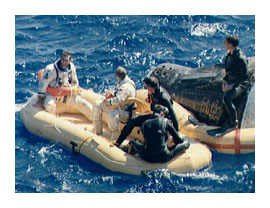
The accuracy of automatic reentry was thoroughly demonstrated when the spacecraft landed within 4.6 kilometers of the U.S.S. Guam, the prime recovery ship, a sea-going platform for helicopters. The crew and spacecraft floated down to its landing, after 71:17 hours elapsed time.
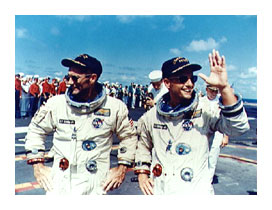
All primary objectives had been accomplished and the last docking with Agena had been added to the mission plan due to the favorable fuel supply.
Please visit www.DickGordon.com